Robes for Tibetan officials in old times were very much influenced by the Han culture. Starting from the Tang Dynasty (618-907), the ties between the Han and Tibetan nationalities gradually became close and the advanced production technique of the Central Plain promoted the development of textile industry of Tibet which had direct bearing on the costume.
At the same time, big quantities of textiles were brought to Tibet from the Central Plain, which played a positive role in improving the texture and pattern designs of Tibetan costume. The cultural exchanges also helped to improve the technology of Tibetan textile industry. The close relation between the Tibetan Nationality and other nationalities of the country further developed from the Yuan Dynasty (1206-1368).
Some officials in the local Tibetan Government starting from Phags-pa became related by marriage with the royal family of the Yuan Dynasty and the exchanges of silk, fur and woolen cloth were even more frequent. The costume and ornaments of high-ranking Tibetan officials and nobles of this period were either imitating or given by the Yuan dynasty.
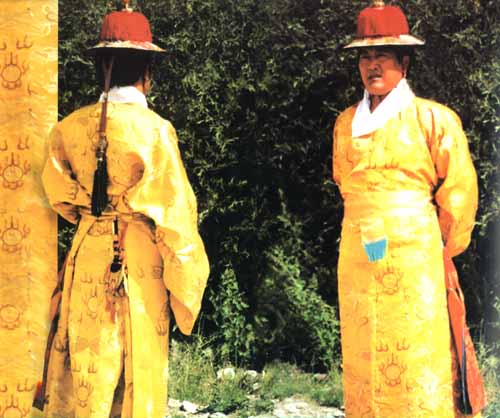
Before the democratic reform in 1959, the robes for officials of the local Tibetan Government were different in texture and patterns which showed the difference in rank. In terms of texture and patterns, there were the boa-design brocade robes, cunzhabaimajiajia (lotus-phoenix-design brocade robe) and cunzhahuaerbaima (lotus-design Mongolian brocade robe).
The boa-design brocade robe used yellow, red, blue, green, white and purple brocade as the key note and had patterns of dragon, water, fish, cloud and mountain. Thry were for officials above the 4th rank when they were granted an audience with the prince, Dalai Lama or head of Lamaism or when a major festival was celebrated or a big ceremony was held.
The lotus-phoenix robe and the lotus robe were for officials above the 4th rank to wear on the New Year or a holiday. Besides, there were the brocade robes with round flower patterns and qujin robes, which were also precious articles of clothing in Lhasa and Xigaze.
Noble dames also had ranks. The elderly wives of officials of the 4th rank were called lcam-mo-sku-zhabs. The wives of the close relatives of Dalai Lama were called lha-lcam-sku-zhabs. The wives of other officials were called lcam-chung-sku-zhabs.
There were mainly two kinds of robes for these noble ladies and their daughters phyu-pa-phu-med (sleeveless robe) and phyu-pa-phu-yod (robe with sleeves), all made of tshon-khra-can (embroidered brocade). The underwear for women were called vog-vjug, with loose collar, short length and long sleeves which usually extended a foot beyond the fingers.
Historically, a hat was the symbol of a man's position, learning and property. It is true of the Tibetans as well. The main symbol for the ranks of the local officials in Tibet was the decoration on the zhua-mo-lcags-mdav (round hat) pearl for the first rank, gem for the second rank, coral for the third rank and turquoise for the fourth rank.
There were no legally-instituted differences for the headwear of ladies, but there were customary differences. For example, the headgar for hereditary noble ladies in the front and rear regions of Tibet was called mu-tig-spa-phrug (pearl decorated headgear), which ordinary noble ladies were not allowed to wear.
Ordinary noble ladies, including wives of big businessmen, could only wear byu-ru-spa-phrug spa-phrug (coral decorated headgear). As to A-sgor (big earring), gave (Buddhist box hung at the chest) and precious necklaces, even ordinary women could wear them and their textures might be different because of their economic status.