The Labrang Monastery is known by two other names: the Lhadrang Zhaxichi, and the Amdo Zhaxigomang which means an auspicious place in Amdo. The First Living Buddha Jamyang, the abbot of the monastery, once studied Buddhist scriptures in the Zhaxigomang Zhacang of the Zhaibung Monastery in Lhasa.
Located in west Xiabe County, Gannan Tibetan Nationality Autonomous Prefecture in Gansu Province, the Labrang Monastery sits on the northern bank of Daxia River. The river flows from west to northeast, taking the shape of a right-turn conch. The area is auspicious and holy in the eyes of the Tibetans. Northwest of the monastery is an elephant-shaped mountain, and southeast of it is a mountain covered with emerald pine trees.
The First Living Buddha Jamyang built the monastery in 1709 at the request of Beleg Chakhan Dainzin of the Qianshou Banner of the Mongol Hoshod in Qinghai. It has since grown to include six major Zhacangs (colleges), 48 Buddha halls and residences for the Living Buddhas, and some 500 living compounds for monks. In terms of size, it is referred to as "the minor U-Tsang" in Amdo. In 1961, it was listed as a cultural relics unit subject to Gansu provincial protection. In 1982, it became a cultural relics unit subject to national protection. The Central Government has since earmarked money to renovate it.
The six Buddhist colleges (Zhacang) in the monastery are: Tiesam Lamwa, Jumaiba, Judoba, Dingker, Manba and Jido Zhacangs.
The Tiesam Lamwa Zhacang, also known as the Grand Sutra Hall, is where monks with the monastery study the open school theories of Tibetan Buddhism. The monks adhere to the same rules and regulations of the Gomang Zhacang in the Zhaibung Monastery in Lhasa. Monk students study Tripitaka (sutrapitaka, vinaya-pitaka and abhidharmapitaka), Trisiksa (Three Studies) and Four Major Doctrines (vipasa, sautrantika, Idealism and Madhyamika-sastra). The monks engage in a 15-year study program that consists of face-to-face teaching, recitation and debating. After completing 13 grades, the students are expected to have a command of the five major Buddhist classics: Hetu (Logic), Prajna, Madhyamika-sastra, Abhidharma-kosa-sastra and Vinaya (Monastic Rule). The Tiesam Lamwa Zhacang offers three kinds of degrees: Ranjamba, Garinba and Dorinba. Generally, those who complete the study of Prajna may apply for the Ranjamba degree examinations, which are given twice a year. Students who finish studying Abhidharma-dosa-sastra receive the Garinba degree. The Dorinba is the highest Buddhist degree offered by the monastery. Only those who complete the study of Abhidharma-kosa-sastra and pass the qualification test by the chief abbot are allowed to take the strict tests. The Living Buddha Jamyang gives qualifying students a preliminary test one month ahead of the final examination. Only those who succeed in reciting the Fundamental Dharma-cakra are qualified to take part in the final examination. Five days before the final examination is held, monk students give daily feasts for students at and above the sixth grade. These feasts serve the purpose of providing instruction and enhancing friendship. Those who fail the test for the Dorinba degree are deprived of future chances. This makes the examinations for the degree, offered to two monk students a year, highly competitive. Recipients of the Dorinba degree become sutra teachers of the young Living Buddhas or sutra teachers serving the monastery at large. Upon death, they may reincarnate.
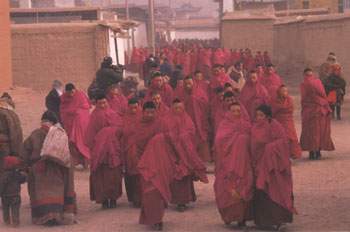
The Jumaiba Zhacang, the Lower Tantric College, is where monk students study Tantric teachings and receive abhiseka. The colletge exercises very strict rules. Students are not allowed to wear silks, and are allowed only minimal amounts of food. And students must refrain from walking with their heads held high.
The Judoba Zhacang is the Upper Tantric College where students further their study of the teachings of the secrete school of Tibetan Buddhism.
The Dingker Zhacang was built by the 2nd Living Buddha Jamyang some 200 years ago in accordance with the instructions of the 6th Panchen Lobsang Huadain Yexei. This college follows the same style as the Time-Wheel College of the Tashilhungpo Monastery. Monk students learn Time-Wheel Sutra while concentrating on studying astronomy and compiling Tibetan calendars. Such Studies play an important part in farming and livestock breeding among the Mongolian and Tibetan peoples in Amdo, and exert influence in Neapl, Bhutan and India.
The Manba Zhacang is the medical college created by the 2nd Living Buddha Jamyang. It follows the style of the Yaowangshan Monastic Medical School in Lhasa and specializes in cultivating monks steeped in Tibetan medicine. The Zhacang is complete with a clinic and a pharmacy. Some of the medicine it produces has found its way into the National Medical Code, and 18 of its prescriptions are accepted nationawide.
The Jido Zhacang features Tantric teachings. Monk students involved in preliminary study couple their learning of Tantric classics with making painted altars. They are also taught music. Monk students involved in secondary study are taught the compilation of Han calendars, Tibetan grammar and calligraphy, and religious dances popular in Tibet. Senior students must abide by three rules and refrain from offending the others. They are required to master Han calendaring.
The Labrang Monastery is, architecturally speaking, a mixture of Tibetan and Han palace styles. It boasts six Buddhist colleges, each of which ahas a sutra hall, 18 residences for the Living Buddhas, 18 Buddhist Lhakangs, sutra buildings and a sutra printing house. The monastery buildings have white dagobas in the northeastern and northwestern sections as symbols. The grand sutra and Buddha halls are all located in the northwestern part centered around the Grand Sutra Hall of the Tiesam Lamwa Zhacang. Other halls spread in a shape similar to a crescent moon.
The monastic buildings are of stone-wood and clay-wood structures. All the sutra and buddha halls have light green quartz walls. Around the hall roofs are brownish low walls, adding holy luster to the halls. The Grand Sutra Hall measures 11 bay long and 15 bay wide. The inside of the hall is made of wood, and is propped up by 140 giant pillars. It is large enough to accommodate 3,000 sitting monks. The elegantly decorated hall has portraits of Buddha on four walls and built-in Buddha shrines and book cases. Fine tangka paintings hang from giant pillars, and there is a magnificent canopy topped with silks embroidered with dragon patterns. The Grand Gold Tile Hall, or the Hall of Maitreya Buddha, is representative of the monastery's Buddha halls and is strongly tinged with a Nepalese flavor. It houses the 10-meter-high gilded statue of Maitreya Buddha created by the Nepalese artisans.
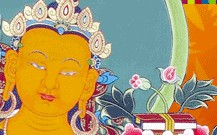
The Labrang Monastery boasts more than 10,000 statues of Buddha made of gold, silver, copper, aluminum, ivory, sandalwood, jade, crystal and clay. In addition, the monastery possesses many Buddha hats adorned with pearls, jadeite, agate and diamond. These Buddha statues are all lifelike with kind-looking faces.
The Labrang Monastery has a collection of close to 10,000 tangka paintings by artists from Wutum (hometown of Tibetan paintings) in Qinghai Province.
The Labrang Monastery boasts about 65,000 Buddhist scriptures in 18,200 volumes (except for Gangyur and Dangyur), one of the richest collection of Buddhist scriptures. These scriptures fall into a dozen categories, including philosophy, collected works, Tantricism, medicine, sabda (grammar and composition), history, biography and craftsmanship. Also included are two volumes of Pattra-Leaf Stutras, and some 70,000 pieces of sutra printing wood blocks.
The Labrang Monastery also has many certificates of appointment and seals of authority issued by the Central Government during and after the Qing Dynasty (1644-1911) to the various generations of Living Buddha Jamyang and other Living Buddhas.
The Labrang Monastery claims to have 108 monasteries under its jurisdiction. As a matter of fact, there should be more. The monastery historically maintained close ties with Tibetan Buddhist monasteries in the Tibetan areas in Gansu, Qinghai and Sichuan. Even today, it has close ties with monasteries in Inner Mongolia, Tibet and the Wutaishan Mountain in Shanxi Province. Blessed with numerous eminent monks, it attracts and endless flow of monks from various parts of China who travel there for study.
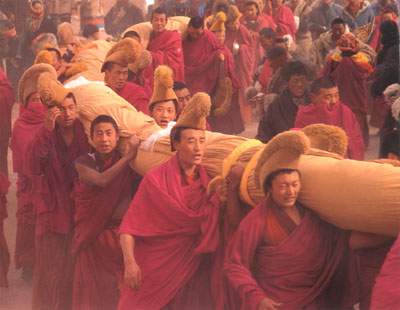
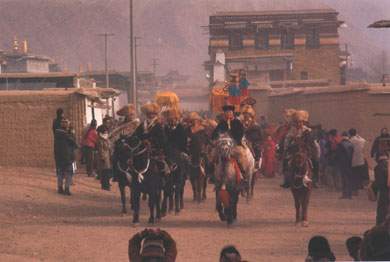
The Labrang Monastery holds seven large-scale summons ceremonies a year. They include the Summons Ceremony in the first lunar month and the Buddhist Doctrine Explaining Pitual in the seventh lunar month. The Summons Ceremony lasts from the evening of the third to 17th day. During this period, the monks recite Buddhist scriptures six times in the Grand Sutra Hall while the Prince of Dharma Dance is performed and the Butter Lamps Festival is held. The Buddhist Doctrine Explaining Ritual held in the seventh lunar month starts on the eighth day. During this period, monks of the monastery gather seven times for lectures or debate on Buddhist doctrines. The monastery's dance group performs a drama that shows how the Holy Monk Milha Riba wins over Goinbo Doje, a hunter. The performance, held in the square of the Grand Sutra Hall, is accompanied by drums and cymbals from the monastery's monk band. The 1st Living Buddha Jamyang, the first abbot of the monastery, organized a monk dance group and a monk band, introducing music from Tibet. Later, the group learned to perform music popular with the imperial court of the Qing Dynasty in the hinterland. The band performs Riwoze'a (Wutaishan Mountain) and Eternal Rejoice, a Qing court music. The monastery dance group also performs Songtsan Gambo and Princess Wencheng, Chimaigendain, Prince Norsang, Zholwa Sammo and Tubo King Trison Detsan.
For the protection of the monastery's cultural relics, the Central Government allocated 800,000 yuan to build a Sutra Collection Hall in the early 1980s. When the Grand Sutra Hall was damaged by fire on April 7, 1985, the Central Government earmarked 12 million yuan for its reconstruction. It was rebuilt in 1990, followed by construction of the Gointangcang Bronze Dagoba, which is unique not only to the monastery, but to Asia at large. Nowadays, all the building in the monastery have been renovated to resume their traditional grandeur.