When Macik Labdron was 43 years old, her husband left Tibet for India. He left their children in her care. Since then Macik Labdron had to take care of her children alone while spreading Buddhist teaching. She taught her children the teaching of Joyul sect. Her children, except the eldest son Drupa (grub-pa), learned Buddhist teachings from her, and became her main successors and propagators of Joyul sect. Macik Labdron devoted herself whole-heartedly to propagating Buddhism. She was engaged in writing and compiling Buddhist works and set forth her teaching. She wrote and compiled the following works: Essence of Doctrines and the Most Important Secret of Joyul Sect on Prajna-paramita, A Great Buddhist Version of the Secret Teachings of Joyul Sect on Prajna-paramita, The Grade of Quintessence and The Grade of Essence.
With these works her teachings were improved and systemized. According to Annals of Tsang, "Shanggyurme, or gyurme Jodam, inherited the tradition of Kang Yeshe Gyaltsen and that of his tutor Chatsa Marpo in Lhonam to the southwest of Shekar and Gyantse. He knew very well the teachings of Shichepa (zhi-byed-pa). He wrote "The Teaching of Nine Grades of Four Ears." There was a stupa at this place for the remains of Shanggyurme and a Kangchen Monastery of Macik Labdron."3 It shows that Macik Labdron spread the teaching of Joyul sect in Tsang, or the place including Gyantse of Shigatse area today.
Macik Labdron's biography says: "Her disciples were numerous." Particularly she trained a large number of nuns, who played a great role in improving the quality of and raising the status of Tibetan Buddhist nuns. She promoted the development of nuns in the Second Propagation of Tibetan Buddhism. Besides, she cured the diseases of thousands of people. Particularly she won a high reputation for curing leprosy in Tibet.
Macik Labdron, who was called the "Reverend Mother" or the "Great Mother, "an excellent representative of Tibetan nuns and a female leader of Tibetan Buddhism, died at the age of 95 in 1144.
The Joyul sect of Tibetan Buddhism or female-lineage Joyul sect, which Macik Labdron founded with her unusual wisdom and thinking, unique viewpoint and practical experiences, had a specific religious theory and way of meditation. And so it made a great impact on other sects of Tibetan Buddhism and also on Tibetan society. The teachings and rites of Joyul sect played a certain role in Tibetan social life for hundreds of years. Macik Labdron was worshipped as the incarnation of a Wisdom Dakini. To this day some monasteries still have images and Tangkha pictures of Macik Labdron for people to worship. The Gomrikha Drolma Female Rinpoche lineage, which came from her, continues today.
Joyul sect had several lineages after it's founding by the end of the 11th century, and they spread far and wide in Tibet. This was the first prosperity of the Joyul sect. The sect did not pay attention to the construction of monasteries or temples, nor did it rely on local authorities. It did not have rigid rules for organization. Particularly it had no solid economic base. As a result, its life period was as short as Shichepa. It no longer existed as a religious sect by the late 16th century. However, as a philosophical school it still had its teachings and rites absorbed by the other schools of Tibetan Buddhism. Its teachings and rites not only became a part of other schools, but also spread among the followers of other schools who did not discriminate alien sects. For instance, the "Ear-tradition of the Joyul Sect" was found in the Gelug sect, the most influential Tibetan Buddhist sect, and the tradition was passed on and had considerable impact on Tibet. The Joyul sect again prevailed in Tibet in the early years of the 20th century. This was its second prosperity. So, we can say that in number of clerical and secular followers the Joyul sect was the biggest one among the sects of Tibetan Buddhism.
Now, some teachings and rites of the Joyul sect and important works by Macik Labdron, as well as some works by eminent monks of other sects such as the works of Gelug sect on the Ear-tradition of Joyul sect and those by Dharmaraja Rinchen Dorje, still exist in Gelug sect, Nyingma sect and some other sects of Tibetan Buddhism. The teachings of Joyul sect are still spreading among the Tibetan people, both clerical and secular.
These classical works on the teachings of Joyul sect still prevail in Tibet. They are rare materials for us to study the teachings and rites of Joyul sect, and also the only important heritage of the sect we can find today in China.
3. Nuns of Joyul sect and their unique way of self-cultivation
The teachings of Joyul sect have spread far and wide in Tibet since the late 11th century when the sect was founded. Particularly, the woman Tantric master Macik Labdron's reputation as well as the Joyul sect's specific teachings, rites and way of self-cultivation attracted the attention of many women. Tibetan nuns enthusiastically supported the Joyul sect.
In Tibetan historical annals, Macik Labdron's disciples were too numerous to be mentioned. Her best known disciples included dight individuals whom she taught heart-to-heart, eight disciples whose capacity was equal to hers, and twenty-one disciples who were Mahasiddhas (tantric yogini with great spiritual accomplishments). The first group consisted of four male disciples (her son rgyal-ba don-grub, stong-sde ngag-gi dbang-phyug, grol-sde rgyal-ba vbyung-gnas, and khu-bsgom chos-kyi seng-ge) and four female ones (vbrog-tshan spyan-ne of Lerong, She-lcam dpal-rgyan of Kambar Tsedrong, lung-da mdo-tsha vbum-rgyan,and vphan-yul myang-mo bsod-nams-rgyan.) The second group consisted of Sgye-med gar-yam of Dwaksporong, who was equal to Macik Labdron in perceptual knowledge; Phu-myang rdo-rje seng-ge of Latho Phagdru, who was equal to her in enlightenment; byang-mo de-nyings-pa rang-rong, who was equal to her in empowerment; rdol-ba seng-thar of Samye, who was equal to her in prohibitions; zhig-po sher-vbum of lob-brag Tenshu, who was equal to her in capacity; dgeldan seng-ge of Phanyul, who was equal to her in mercy; me-dro rgyal-mgon hag-ston, who was equal to her in supernatural power and magical power, and mgon-po rje-btsun si-lung, who was equal to her in blessings (for the future)and joy (for present). Among them four of the heart-to-heart disciples were female; eighteen of the twenty-one mahasiddhas were female.
Macik Labdron's well-known female disciples in turn had their traditions formed in the process of propagating the teachings of the Joyul sect. The traditions spread far and wide in Tibetan areas. For instance, Macik Labdron's female disciple gtsug-ta-ma founded her tradition and taught disciples such as Dharmaraja Rinchen Dorje, disciple of gnam-mtshoba mi-skyod rdo-rje, founded the Rupa (herdsman) tradition of the Joyul sect, from which came Nedo tradition and Gyache (Great Protection) tradition. These traditions had great impact on Tibetan areas.
Macik Labdron's four female disciples whom she taught heart-to-heart founded a tradition called "Terma (Hidden Treasure) of Female Lineage," which spread wide in Tibetan areas, particularly in the Kham region (present-day Tibetan areas in Sichuan, Yunnan and Qinghai).
Besides, Macik Labdron's daughter Lha-lcam and granddaughter gang-pa mug-yan were well-known nuns of the Joyul sect. Lha-lcam founded a tradition based on quiet practice, violent practice and quiet-violent practice. This tradition had three branches, of which the most influential was the "rgyal-thang Joyul tradition," founded by rgyal-thang-pa bsam-gtan vod-zer.
Macik Labdron's granddaughter Gangpa Moyen, daughter of her second son Toling Sandrup, learned the teachings of Joyul sect from her father, She taught disciples and propagated the Joyul sect.
Machik Lhadron's second son Toling Sandrup founded the "Tradition of Black Hat of Snowy Mountain." This tradition had many nuns of Joyul sect. Toling had "twenty-one male and female chief disciples" and "eighteen female disciples of achievements". Most of them were nuns.
From this it is clear that Joyul sect had many wellknown nuns. They were chief successors and propagators of the teachings and rites of Joyul sect. To this day the teachings and rites of Joyul sect are still cultivated and propagated by the nuns of all sects of Tibetan Buddhism.
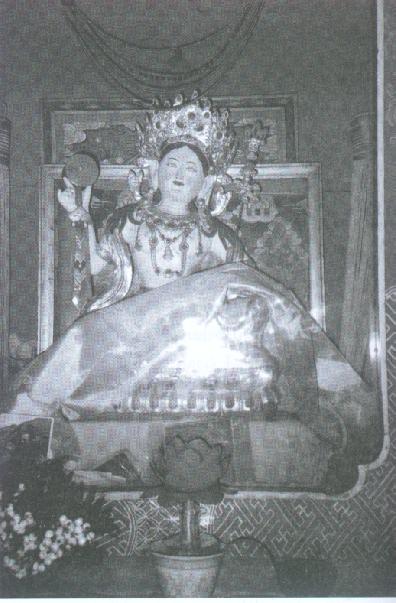
Preserved in Labrang Tawani Monastery